Communication Skills
class 9th
1. Introduction to Communication
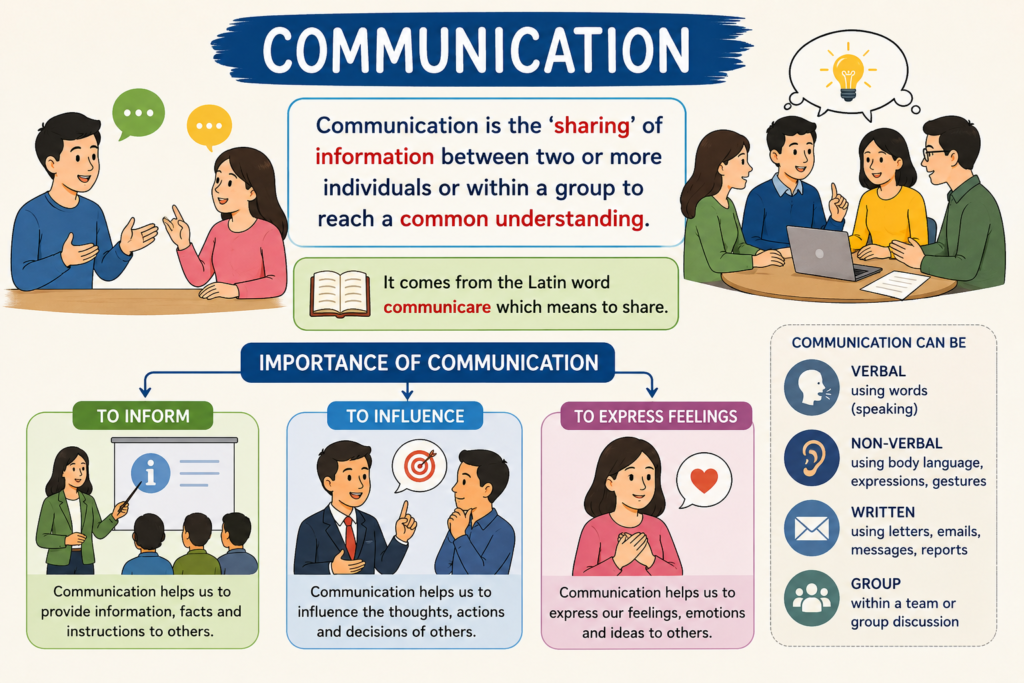
- Definition: Communication is derived from the Latin word commūnicāre, meaning “to share.” It is the sharing of information between two or more individuals or a group to reach a common understanding.
- Purpose of Communication:
- Inform: Giving facts or information (e.g., sharing an exam timetable).
- Influence: Changing someone’s mind or negotiating (e.g., reducing a shopkeeper’s price).
- Express Feelings: A healthy way to share emotions like excitement or stress.
- Elements of Communication: It is a two-way process involving giving information (speaking and writing) and receiving information (listening and reading).
2. Effective Communication and Perspectives
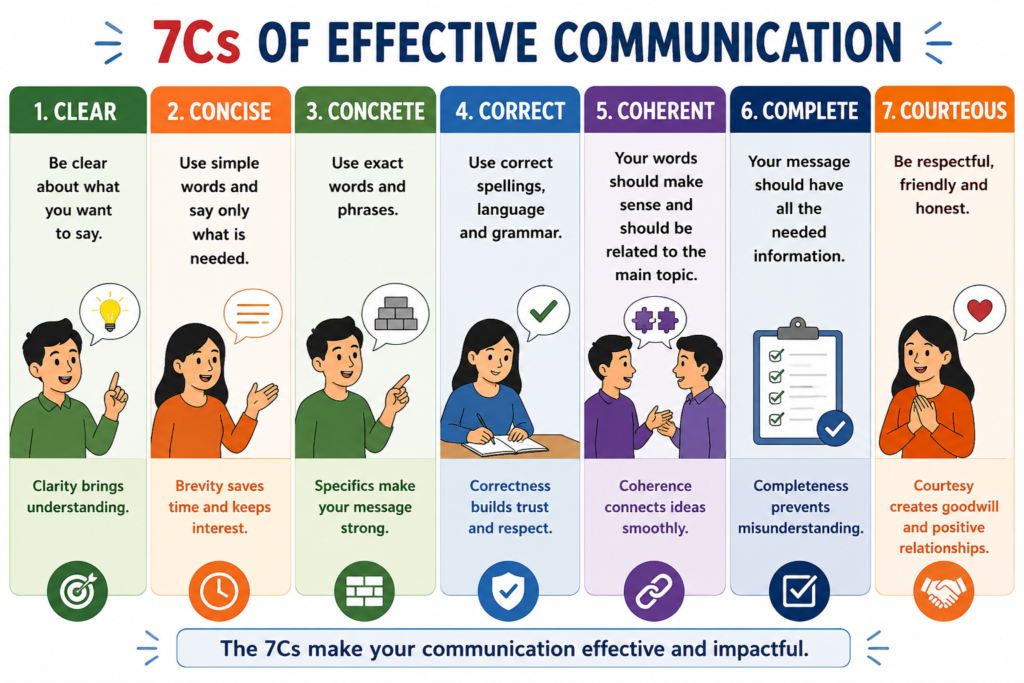
- The 7 Cs: Professional communication should be Clear, Concise, Concrete, Correct, Coherent, Complete, and Courteous.
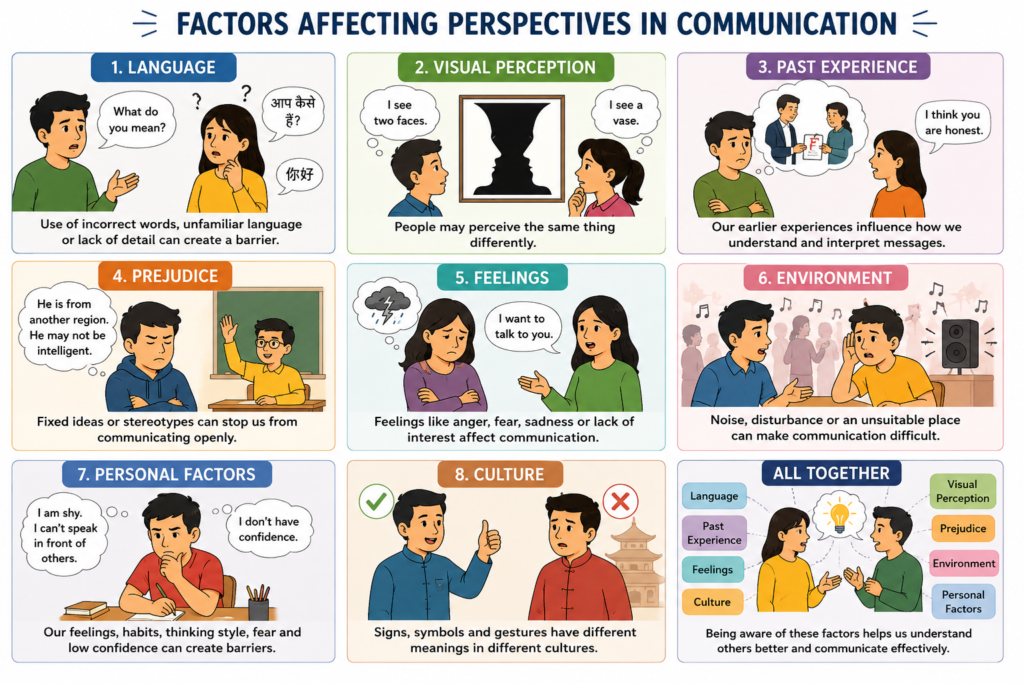
- Barriers to Communication: Perspectives (fixed ways of thinking) can act as barriers. Key factors include:
- Language: Incorrect words or unfamiliar languages.
- Visual Perception: The brain misinterpreting what it sees.
- Past Experience: Letting previous events stop clear communication.
- Other Factors: Prejudice, feelings/emotions, environment (noise), personal factors (fear/low confidence), and culture.
3. Methods of Communication
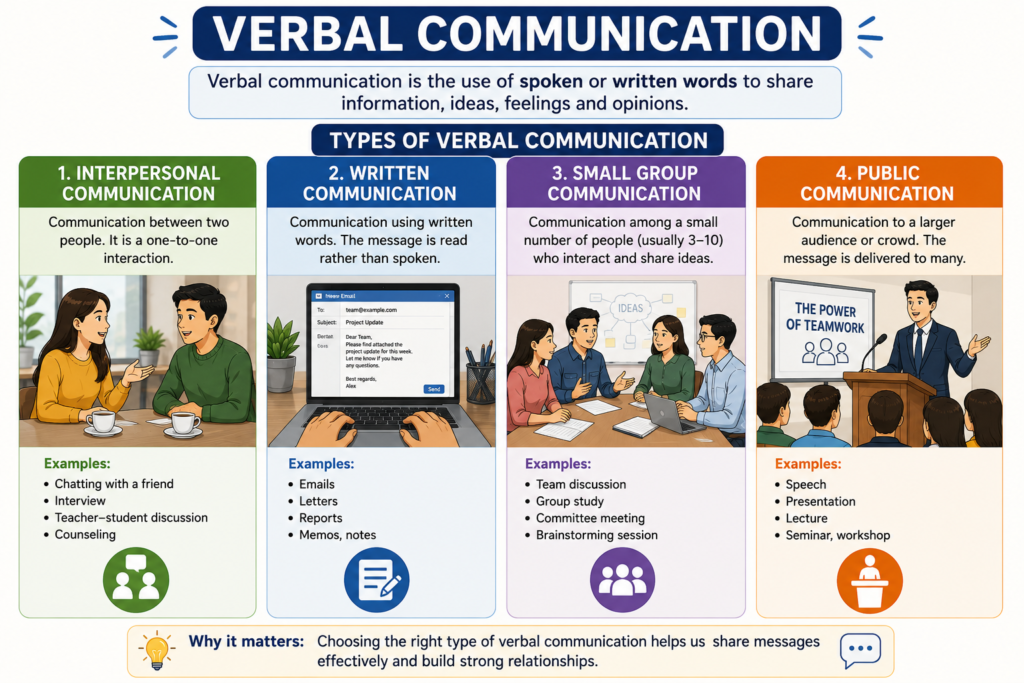
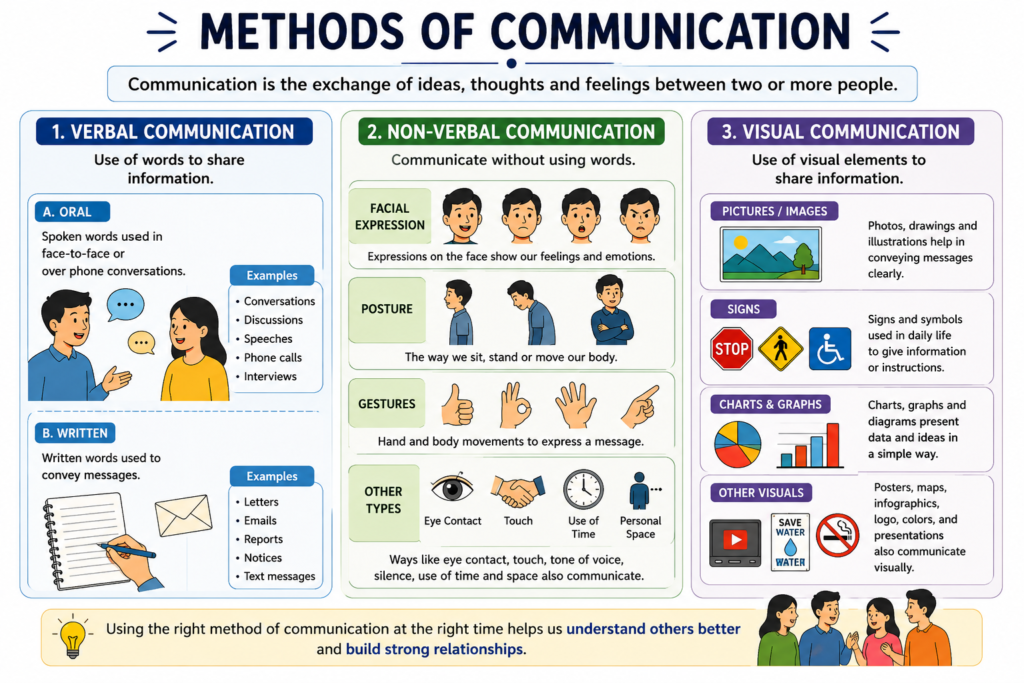
- Verbal Communication: Sharing information using words.
- Oral: Face-to-face conversations, phone calls, classroom teaching, and public speeches.
- Written: Letters, SMS, emails, books, and newspapers.
- Non-Verbal Communication: Exchanging information without words through:
- Facial Expressions: Showing feelings like happiness or sadness.
- Posture: Body positions that show confidence or tiredness.
- Gestures: Movements like waving, pointing, or nodding.
- Other Types: Touch (handshakes), Space (closeness), Eye Contact, and Paralanguage (tone, speed, and volume of voice).
- Visual Communication: Using images, pictures, or signs that remain the same across different places (e.g., traffic lights, “No Smoking” signs).
4. Public Speaking (The 3Ps)
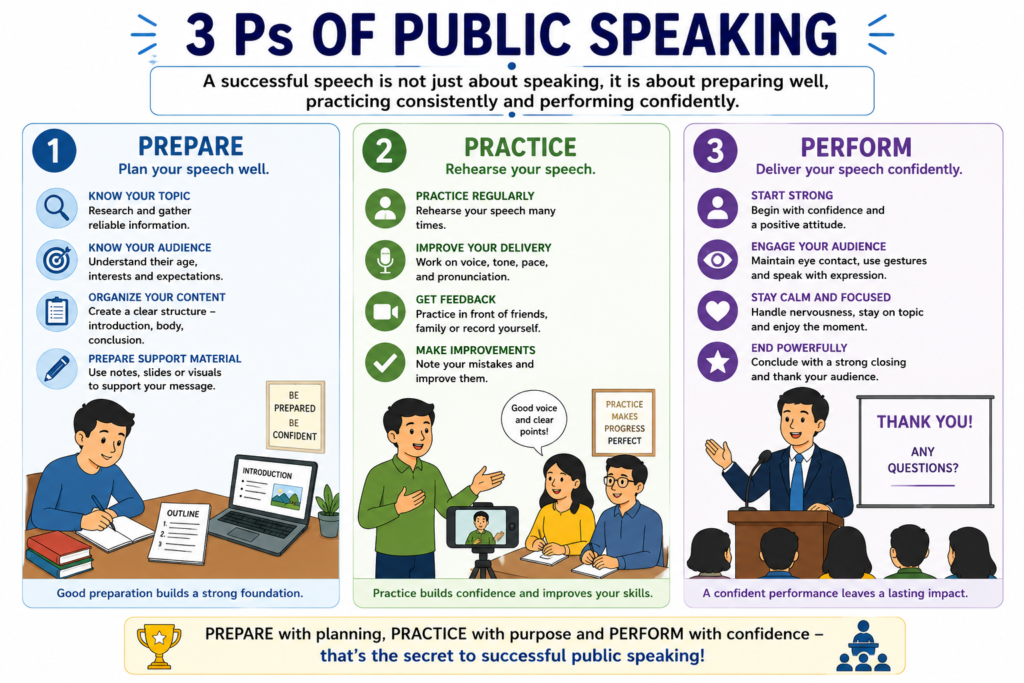
To overcome the fear of speaking to large groups, follow the 3P method:
- Prepare: Think about the topic and what the listeners need to know.
- Practice: Speak in front of a mirror or to friends and family.
- Perform: Take deep breaths and speak confidently at the right speed.
5. Writing Skills
- Capitalization (MINTS Rule): Capitalize Months, the letter I, Names of people/places, Titles (Dr., Mr.), and the Starting letter of sentences.
- Punctuation: Includes full stops, commas, question marks, exclamation marks, and apostrophes to separate parts of a sentence and explain meaning.
- Parts of Speech:
- Main: Nouns (naming words), Pronouns (replace nouns), Verbs (actions), Adjectives (describe nouns), and Adverbs (describe verbs/adjectives).
- Supporting: Articles (a, an, the), Conjunctions (join words/phrases), Prepositions (show relations), and Interjections (express strong emotions).
- Sentences:
- Structure: Usually consists of a Subject (performer), Verb (action), and sometimes an Object (receiver).
- Active vs. Passive Voice: In Active voice, the subject does the action; in Passive voice, the subject receives the action.
- Types: Statement (Declarative), Question (Interrogative), Emotion (Exclamatory), and Order (Imperative).
6. Pronunciation and Greetings
- Phonetics: The study of the sounds we make when we speak.
- Sounds: English uses vowels (a, e, i, o, u), diphthongs (combination of two vowels), and consonants.
- Greetings:
- Formal: Used for seniors, teachers, or elderly people.
- Informal: Used for friends and family.
- Introductions: When meeting someone new, share your name and general information like hometown, interests, strengths, and weaknesses.
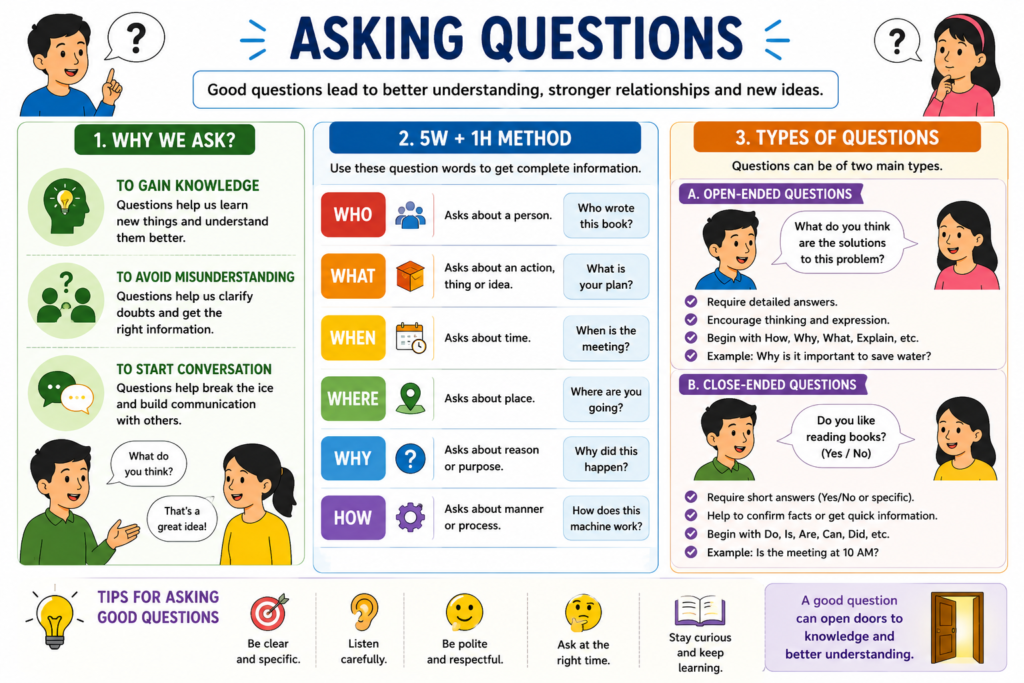
7. Asking Questions
- Why we ask: To gain knowledge, avoid misunderstanding, and start conversations.
- 5W+1H Method: Use Who, Where, When, What, Why, and How to ensure you have complete information.
- Types of Questions:
- Close-ended: Can be answered with “Yes” or “No”.
- Open-ended: Require more detail and use question words.