
Information Threat and Security
chapter 1
Chapter: Information Security and Cyber Safety
1. Information Threat
Definition
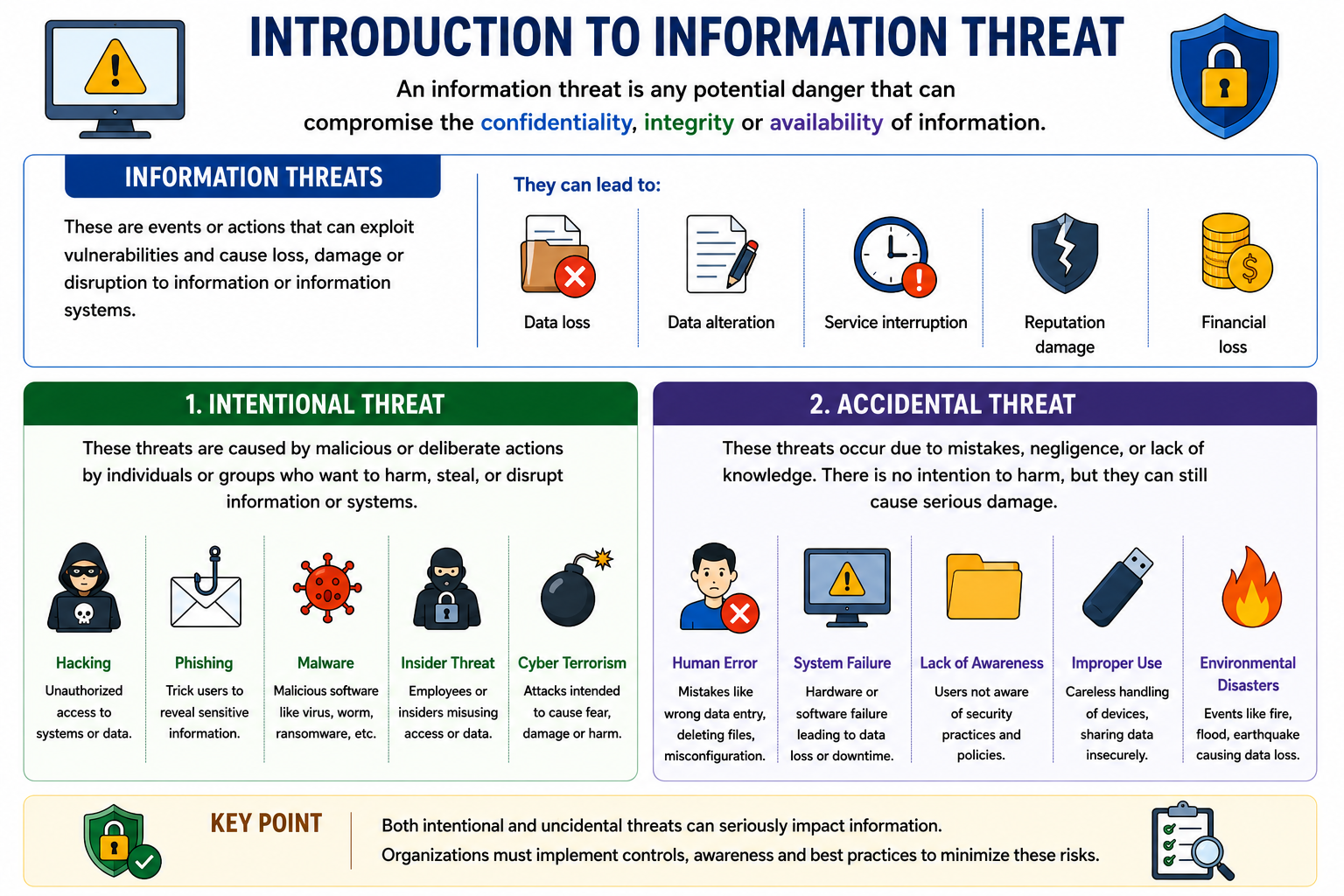
An information threat is any danger that can harm the confidentiality, integrity, or availability of information.
Information Threats
Information threats are events or actions that exploit weaknesses in a computer system and cause damage, loss, or disruption.
Effects of Information Threats
- Data loss
- Data alteration
- Service interruption
- Reputation damage
- Financial loss
Types of Information Threats
1. Intentional Threat
Intentional threats are caused deliberately by people who want to steal, damage, or misuse information.
Examples
- Hacking
- Phishing
- Malware
- Insider Threat
- Cyber Terrorism
2. Accidental Threat
Accidental threats happen due to mistakes, negligence, or lack of knowledge. There is no intention to cause harm.
Examples
- Human error
- System failure
- Lack of awareness
- Improper use of devices
- Natural disasters (fire, flood, earthquake)
Key Point
Both intentional and accidental threats can seriously affect information security. Following good security practices helps reduce these risks.
Malicious Software (Malware)
Definition
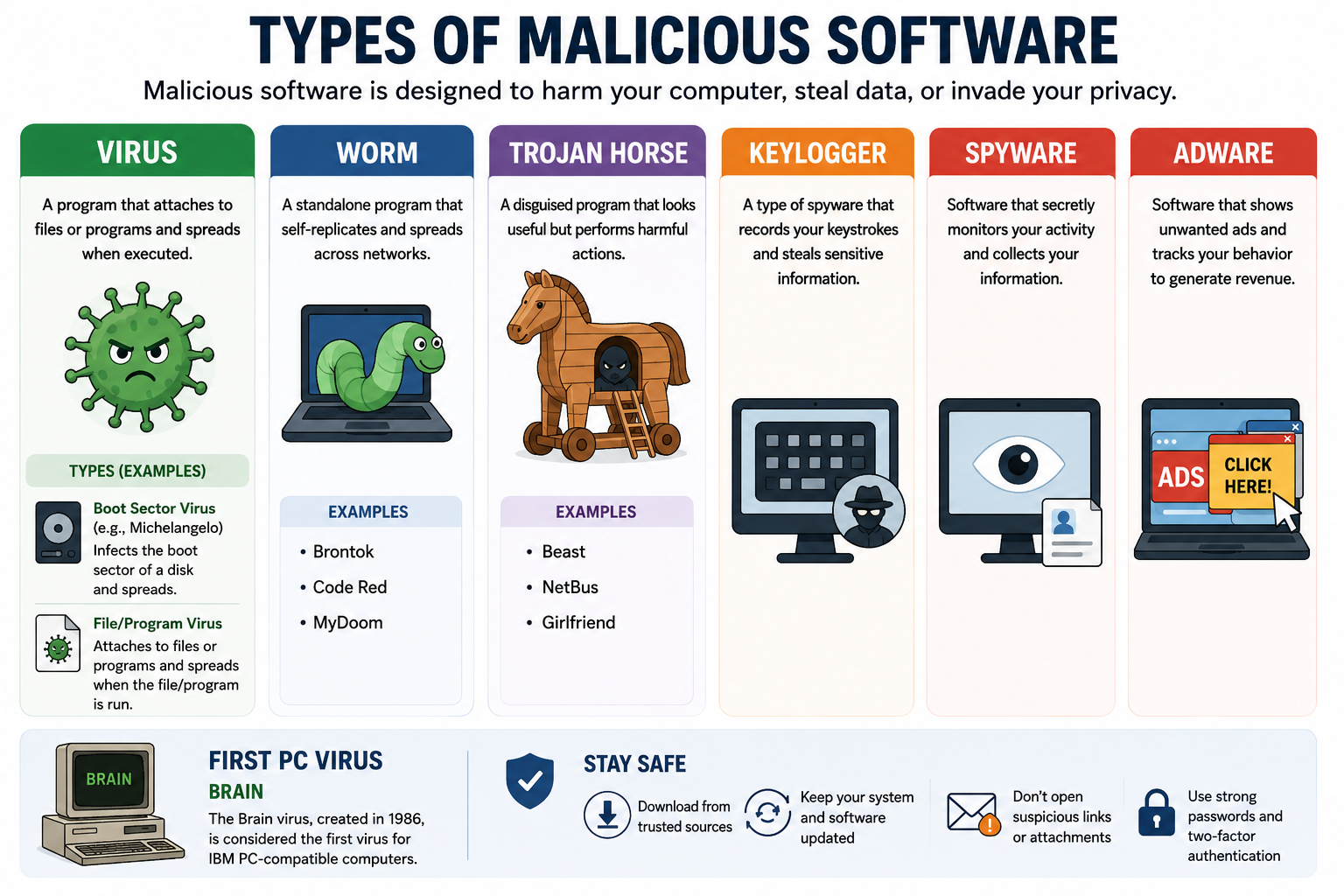
Malware is software designed to damage computers, steal information, or disrupt normal operations.
Types of Malware
1. Virus
A virus is a malicious program that attaches itself to files or programs and spreads when they are executed.
Examples
- Boot Sector Virus
- File/Program Virus
2. Worm
A worm is a standalone program that copies itself and spreads through computer networks.
Examples
- Morris Worm
- Code Red
- MyDoom
3. Trojan Horse
A Trojan Horse is a harmful program that appears to be useful but secretly performs malicious actions.
Examples
- Zeus
- NetBus
- Back Orifice
4. Keylogger
A keylogger records every key pressed on the keyboard to steal passwords and personal information.
5. Spyware
Spyware secretly monitors user activities and collects personal information.
6. Adware
Adware displays unwanted advertisements and may track user activity.
First Computer Virus
The Brain Virus (1986) was the first virus for IBM PC-compatible computers.
Other Malicious Threats
Spam
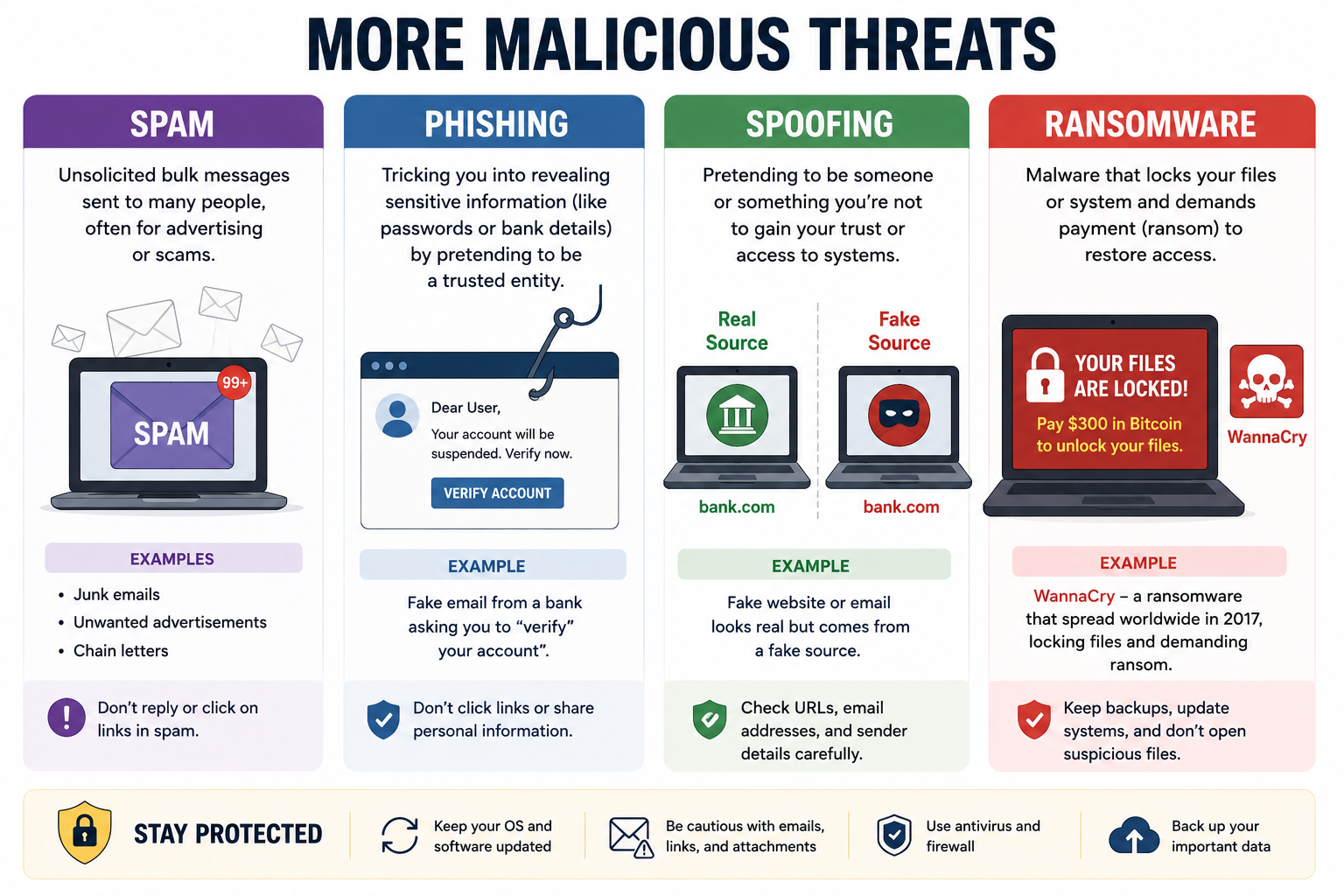
Spam refers to unwanted bulk emails or messages sent to many people.
Examples
- Junk emails
- Advertisements
- Chain letters
Phishing
Phishing is an attempt to trick users into revealing passwords, bank details, or personal information by pretending to be a trusted source.
Spoofing
Spoofing means pretending to be another person, website, or email address to gain trust.
Ransomware
Ransomware locks files or the entire computer and demands money (ransom) to restore access.
Example: WannaCry
Cyber Crime
Definition
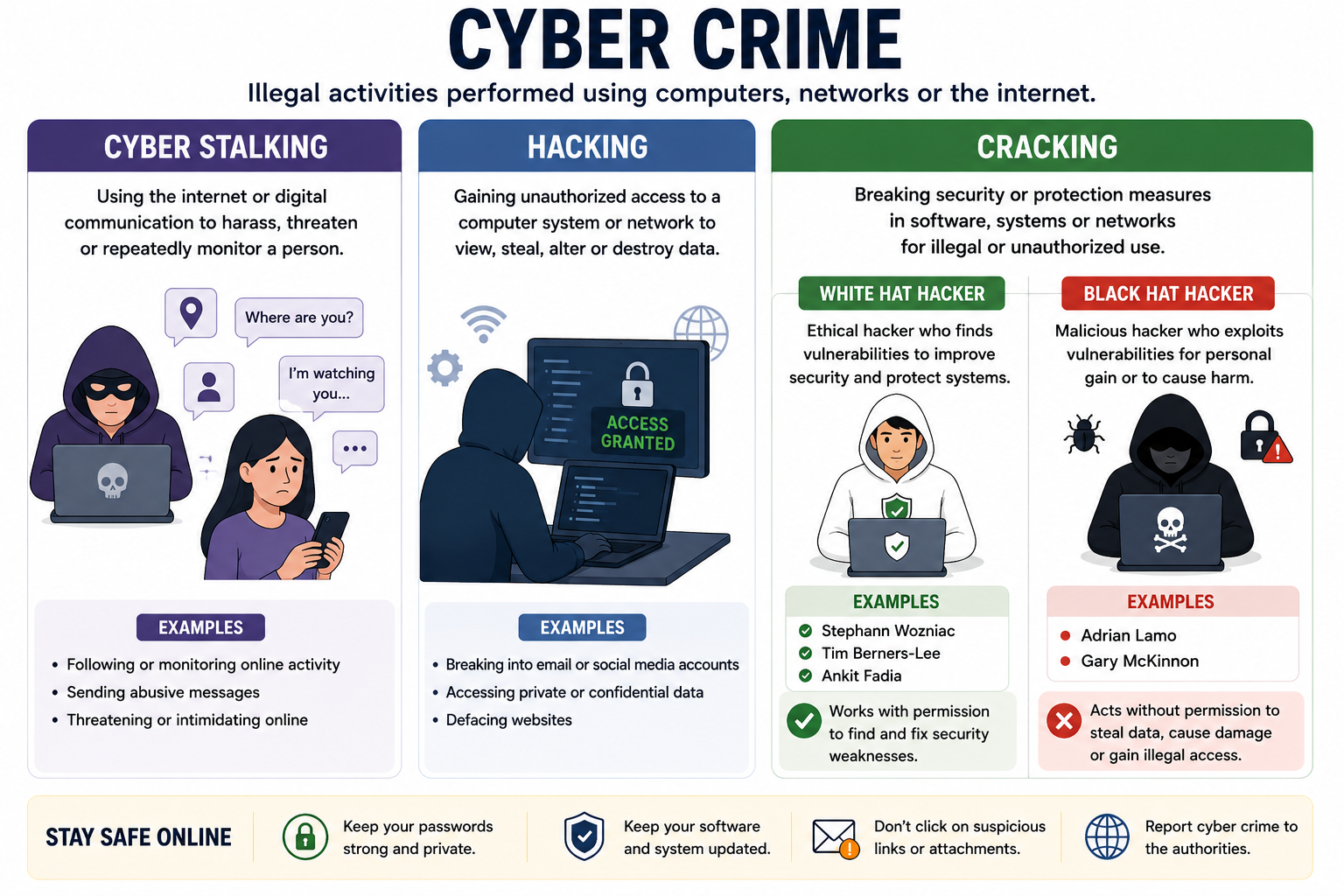
Cyber crime is any illegal activity performed using computers, networks, or the Internet.
Types of Cyber Crime
Cyber Stalking
Using the Internet to repeatedly harass, threaten, or monitor a person.
Hacking
Gaining unauthorized access to a computer system or network.
Cracking
Breaking computer security for illegal purposes.
White Hat Hacker
- Ethical hacker
- Works with permission
- Improves security
Black Hat Hacker
- Criminal hacker
- Works without permission
- Steals or damages data
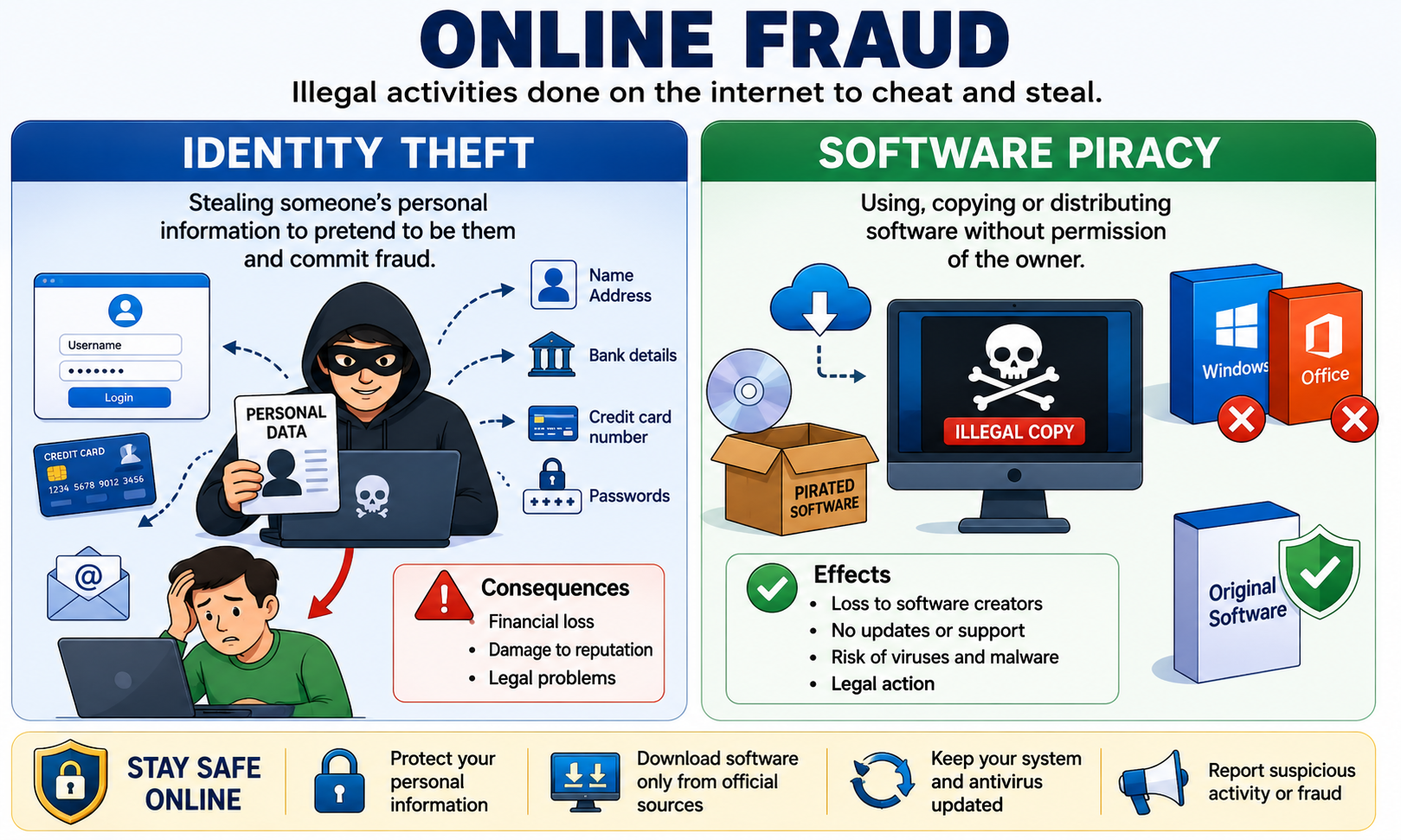
Online Fraud
Identity Theft
Identity theft means stealing another person’s personal information to commit fraud.
Consequences
- Financial loss
- Damage to reputation
- Legal problems
Software Piracy
Software piracy means copying, downloading, or using software without the owner’s permission.
Effects
- Loss to software creators
- No software updates
- Risk of malware
- Legal action
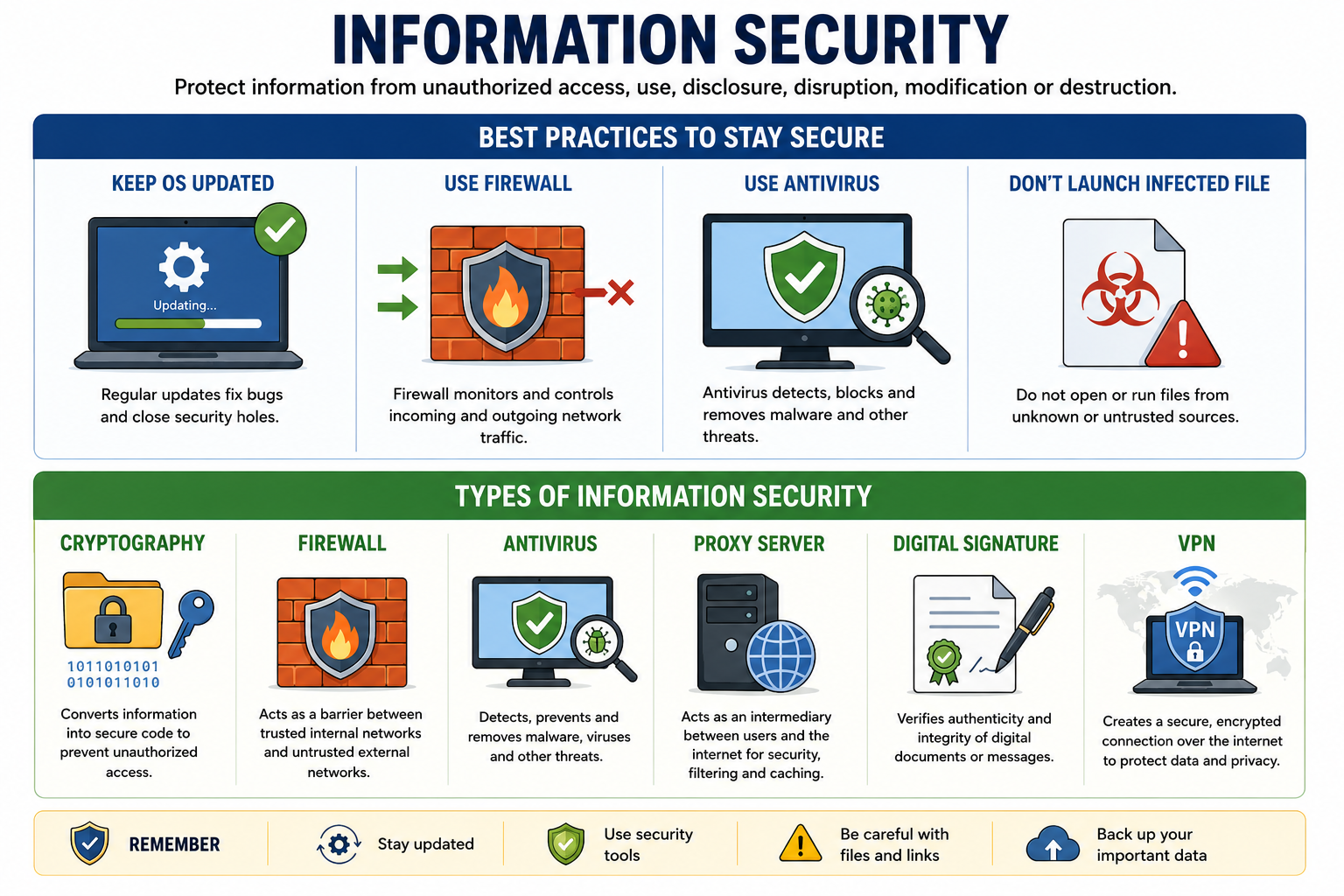
Information Security
Definition
Information security means protecting information from unauthorized access, modification, disclosure, or destruction.
Best Security Practices
- Keep the operating system updated.
- Use a firewall.
- Install antivirus software.
- Do not open suspicious or infected files.
Types of Information Security
Cryptography
Converts readable information into encrypted form to keep it secure.
Firewall
Protects a computer or network by monitoring incoming and outgoing network traffic.
Antivirus
Detects, blocks, and removes viruses and other malware.
Proxy Server
Acts as an intermediary between a user and the Internet.
Digital Signature
Verifies the authenticity and integrity of electronic documents.
VPN (Virtual Private Network)
Creates a secure, encrypted connection over the Internet.
Cryptography
Definition
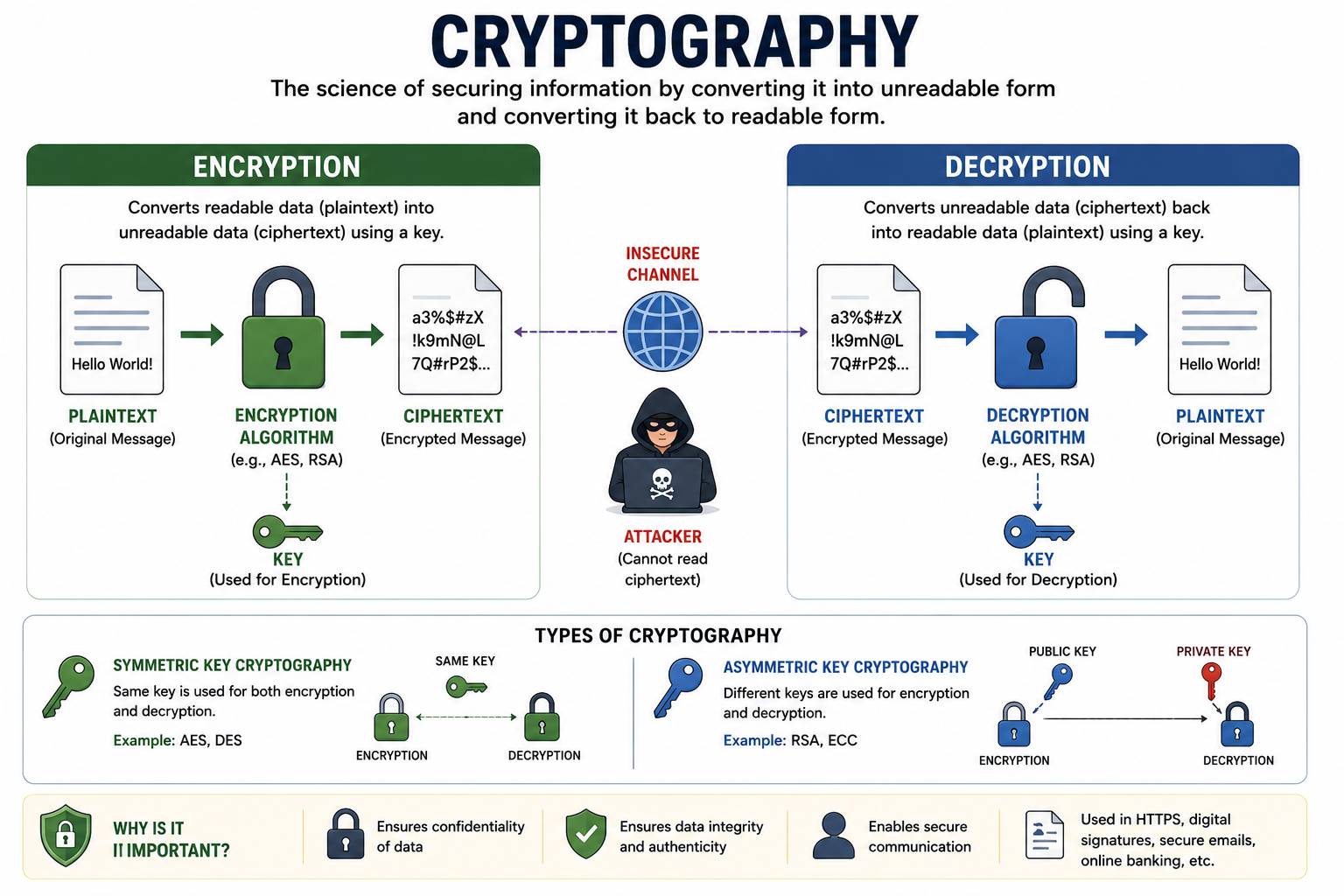
Cryptography is the science of protecting information by converting it into encrypted form and converting it back into readable form.
Encryption
Encryption converts plaintext into ciphertext using an encryption key.
Decryption
Decryption converts ciphertext back into plaintext using a decryption key.
Types of Cryptography
Symmetric Key Cryptography
- Same key is used for encryption and decryption.
- Examples: AES, DES
Asymmetric Key Cryptography
- Different keys are used for encryption and decryption.
- Uses a public key and a private key.
- Examples: RSA, ECC
Importance of Cryptography
- Maintains confidentiality
- Protects data integrity
- Provides authentication
- Enables secure communication
Firewall
Definition
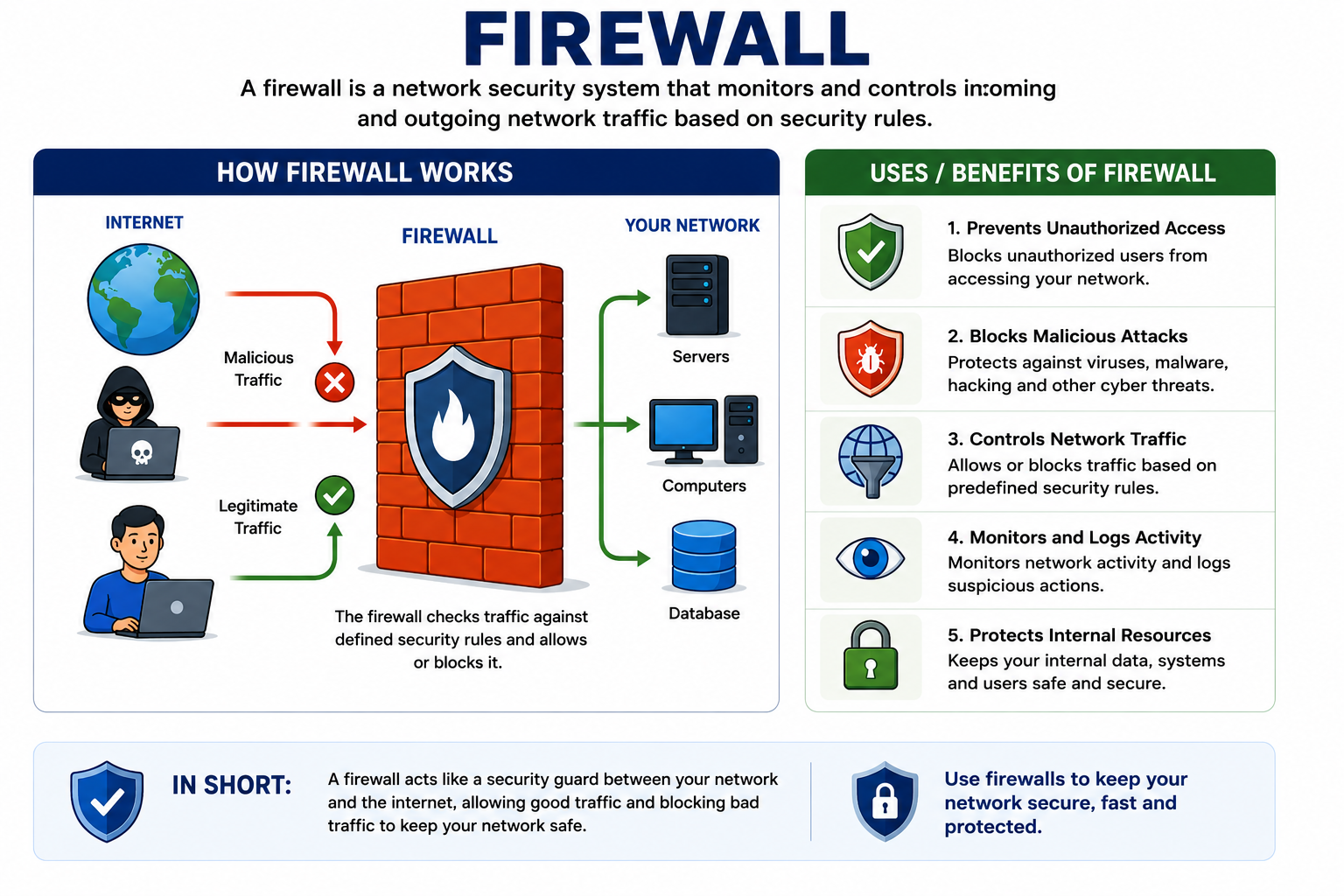
A firewall is a network security system that monitors and controls incoming and outgoing network traffic based on security rules.
Uses of Firewall
- Prevents unauthorized access
- Blocks malicious attacks
- Controls network traffic
- Monitors network activity
- Protects internal resources
Antivirus
Definition
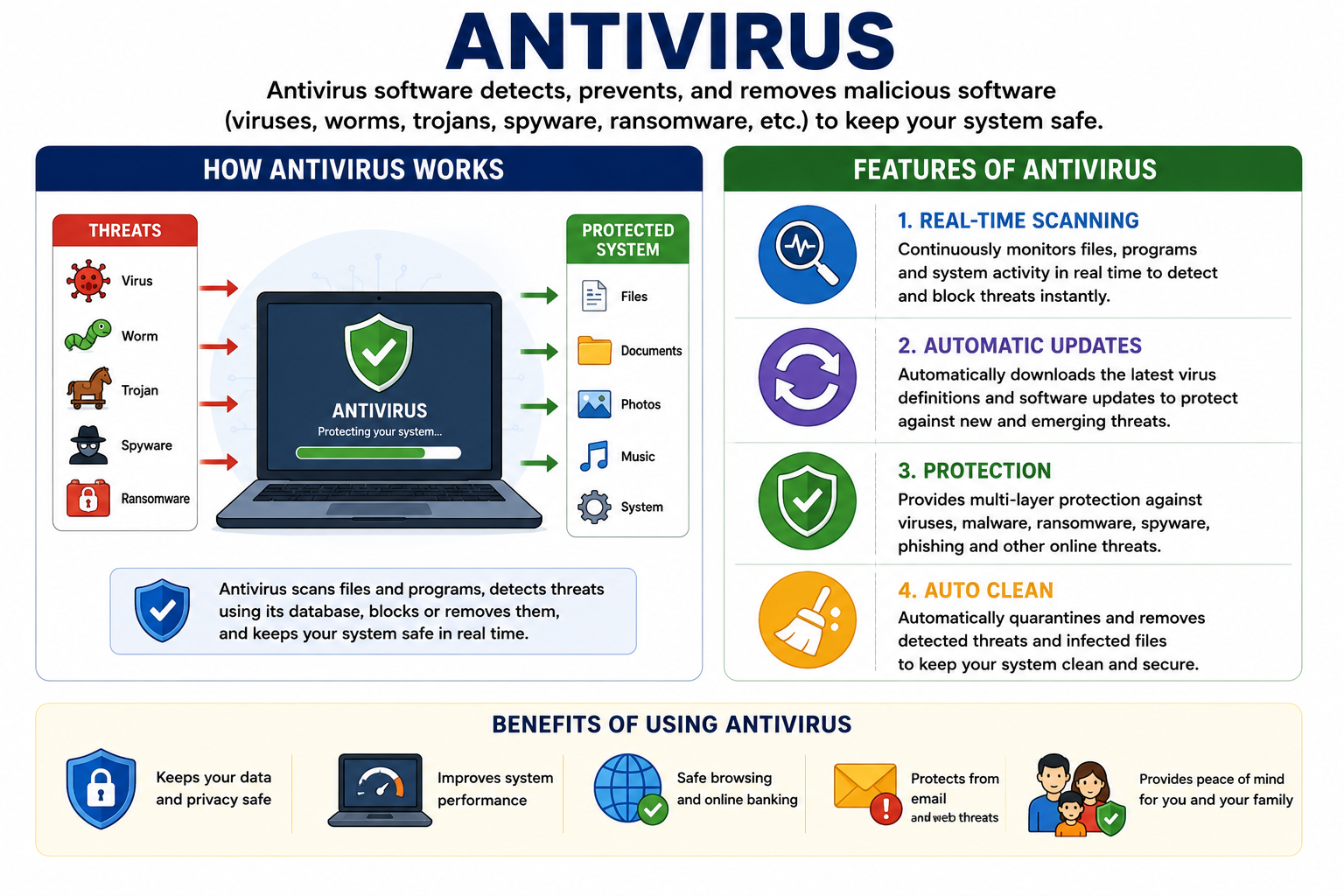
Antivirus software detects, prevents, and removes malicious software to keep the computer safe.
Features of Antivirus
- Real-time scanning
- Automatic updates
- Malware protection
- Automatic cleaning
Benefits of Antivirus
- Protects data and privacy
- Improves system performance
- Provides safe browsing
- Protects against email and web threats
- Gives peace of mind
Proxy Server
Definition
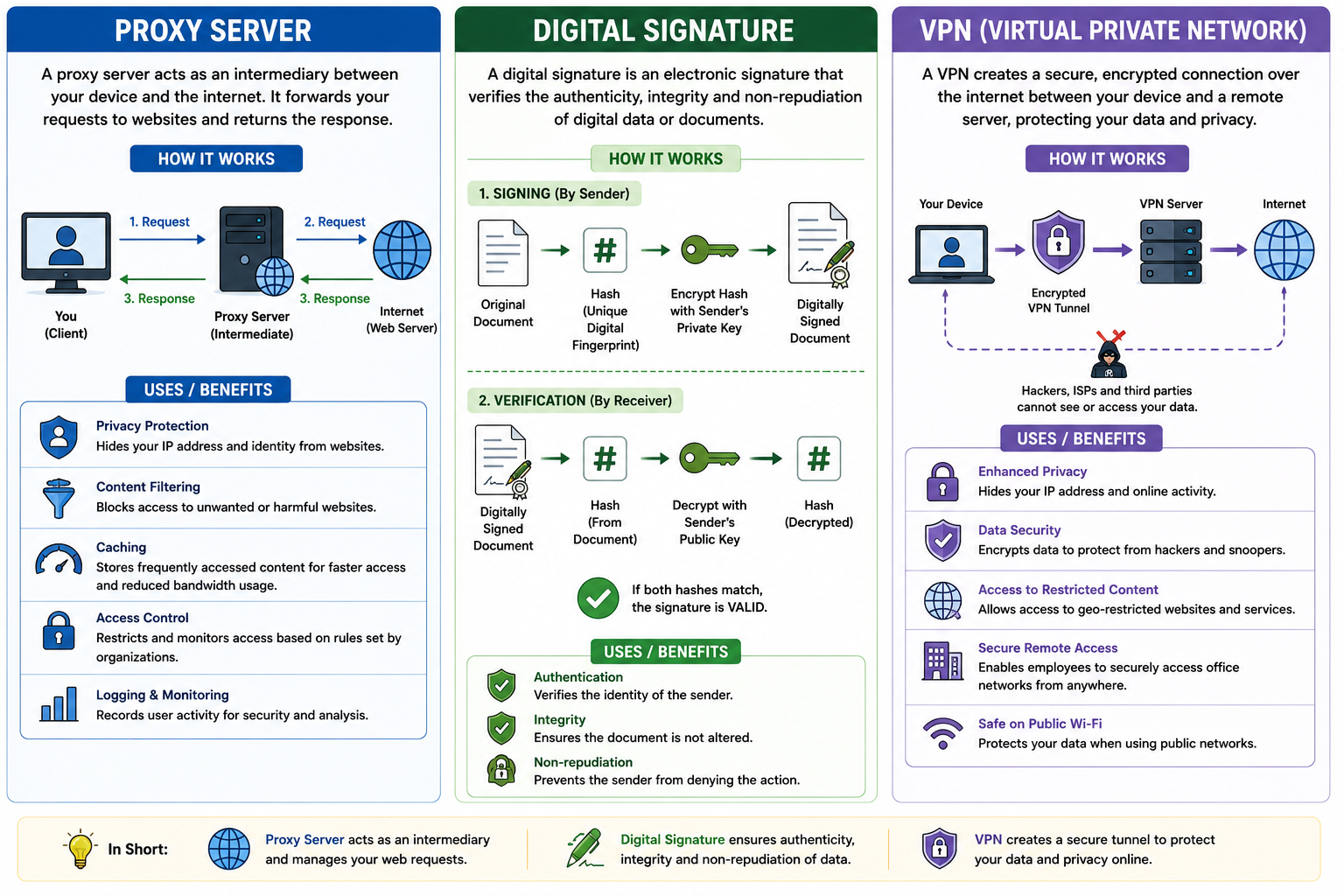
A proxy server acts as an intermediary between a user’s device and the Internet.
Uses
- Hides IP address
- Filters web content
- Improves browsing speed through caching
- Controls Internet access
- Monitors user activity
Digital Signature
Definition
A digital signature is an electronic signature that verifies the authenticity, integrity, and non-repudiation of digital documents.
Benefits
- Authentication
- Data integrity
- Non-repudiation
Virtual Private Network (VPN)
Definition
A VPN creates a secure, encrypted connection between a user’s device and the Internet.
Benefits
- Protects privacy
- Encrypts data
- Allows secure remote access
- Accesses geo-restricted content
- Protects users on public Wi-Fi
Cyber Law
Definition
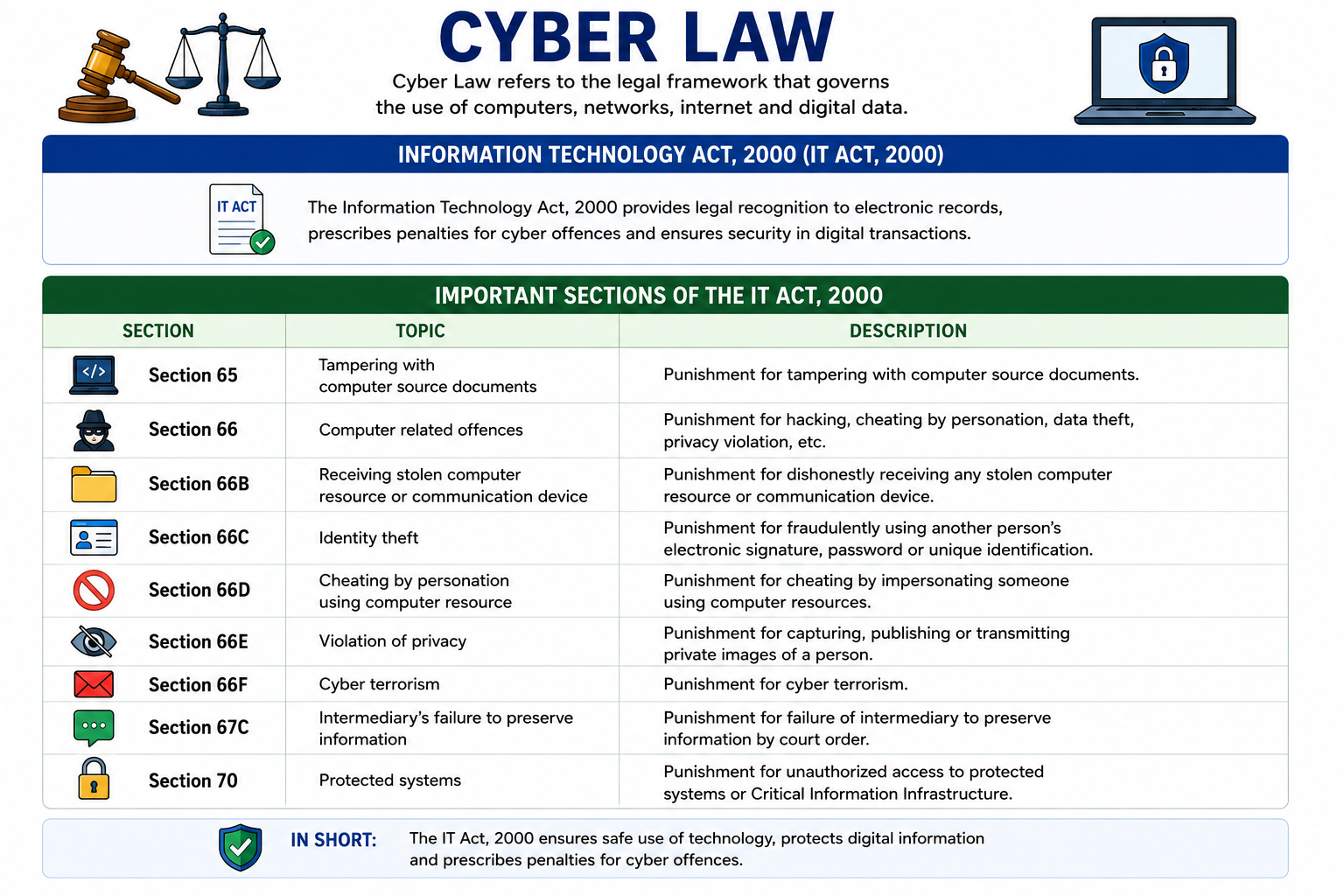
Cyber Law is the legal framework that governs the use of computers, networks, the Internet, and digital information.
Information Technology (IT) Act, 2000
The Information Technology Act, 2000 provides legal recognition to electronic records and helps prevent cyber crimes in India.
Important Sections of the IT Act, 2000
| Section | Topic |
|---|---|
| 65 | Tampering with computer source documents |
| 66 | Computer-related offences such as hacking and data theft |
| 66B | Receiving stolen computer resources |
| 66C | Identity theft |
| 66D | Cheating by personation using computer resources |
| 66E | Violation of privacy |
| 66F | Cyber terrorism |
| 67C | Failure to preserve information by intermediaries |
| 70 | Protected systems |